Roof Truss Anatomy Explained
Roof truss anatomy part by part: top chord, bottom chord, webs, heel height, panel points, bearing and camber, and what each one changes.
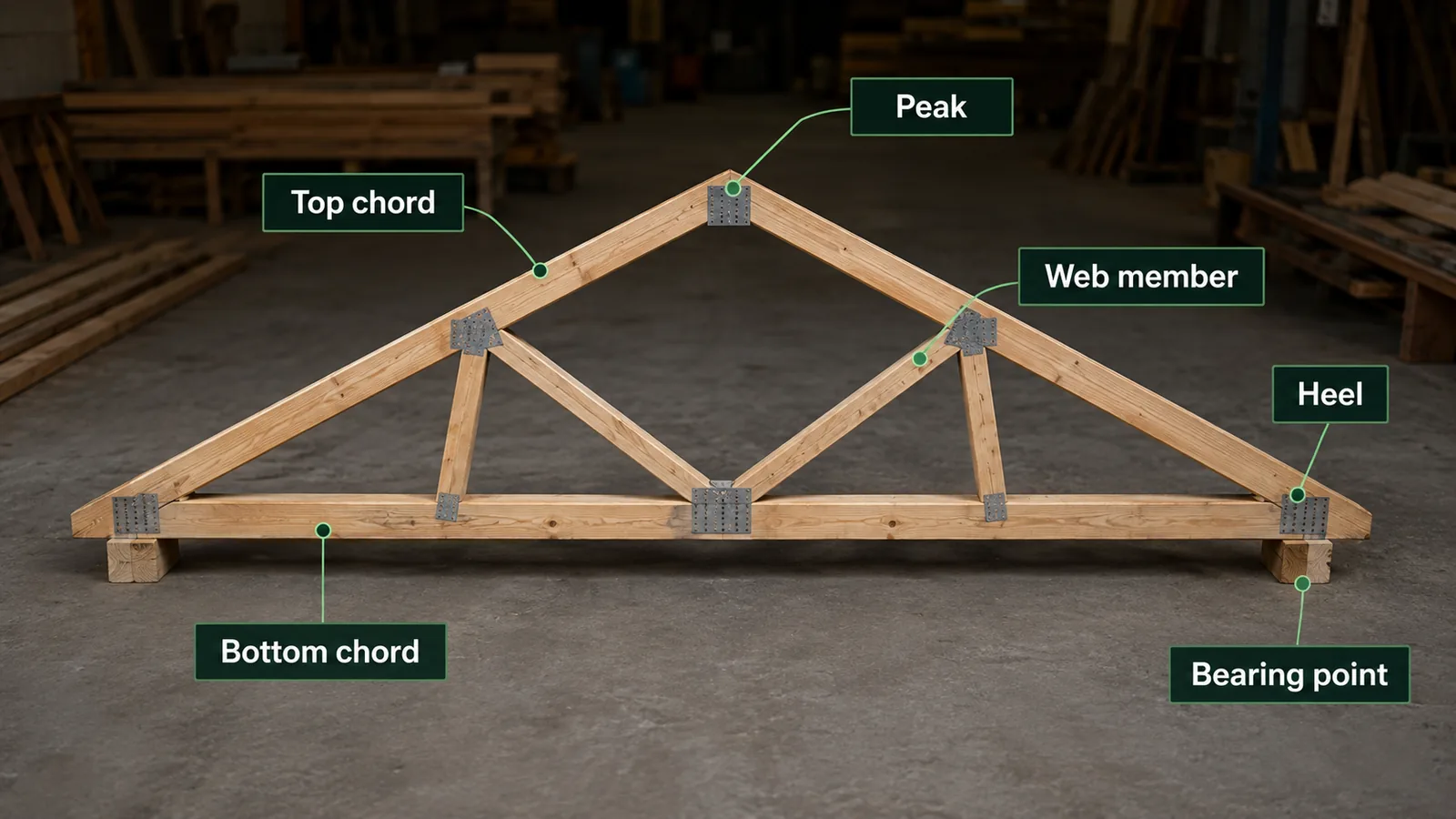
Roof truss anatomy comes down to five parts: two top chords carrying the roof in compression, one bottom chord holding the walls together in tension, the webs transferring load between them, the heel where chords meet over the bearing wall, and the connector plates holding every joint together. Learn those five and a truss drawing stops being intimidating. If you want to see them laid out at your own span and pitch, the roof truss calculator draws each member to scale as you change the inputs.
The vocabulary is unusually literal, which makes it quick to pick up. Here is each part, what it does, and where it changes a decision you will actually make.
Top chord
The sloping members running from the bearing points up to the peak. They define the roof plane, carry the sheathing and roofing, and work mainly in compression.
Because they are in compression, their capacity is governed by buckling (opens in a new tab) rather than crushing. Buckling depends on the unbraced length between web connections, which is why web layout matters so much. More panel points means shorter unbraced lengths, which means more span from the same piece of lumber.
The top chord also continues past the wall to form the overhang. That projecting section is called the tail.
Bottom chord
The horizontal member tying the two bearing points together. It works in tension, and it is the most important member in the truss.
Here is why. Without it, the two top chords would spread apart under load and push the walls outward. The bottom chord is what stops that happening. It is the member that turns a pair of leaning sticks into a stable triangle.
This is also why you must never cut a bottom chord. Not for a duct, not for an access hatch, not for a light fitting. Cutting it removes the tension tie and the truss stops behaving like a truss.
The bottom chord also carries whatever hangs below it: drywall, insulation, and any storage load the truss was specifically designed for.
Webs
The members between the two chords. They move load from the top chord down to the bottom chord and out to the bearings.
Webs alternate between tension and compression depending on their direction and where load sits. In a Fink truss the webs sloping down toward the centre are typically in compression while those sloping outward are in tension. They often look similar, but the compression ones may need lateral bracing that the tension ones do not.
The arrangement has a name: kingpost for a single vertical, queen post for two verticals with a straining beam, Fink for the W, plus Howe, Pratt and double Fink. Our guide to types of roof trusses compares them properly.
Panel point, also called a node
Any point where members meet. Panel points are where loads should be applied and where the truss is designed to transfer force.
Apply a concentrated load between panel points, by hanging a hoist from the middle of a chord for instance, and you put that member into bending it was never designed for. If something has to hang, hang it at a node, and check the design first.
Heel, and why heel height is the sleeper decision
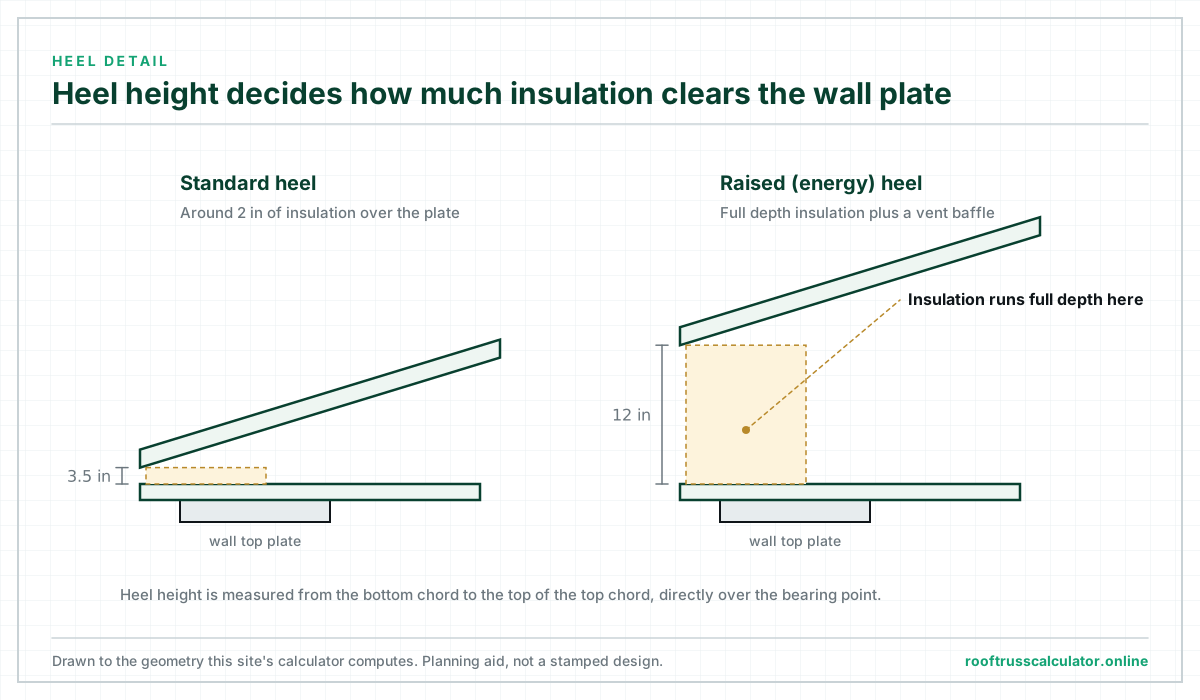
The heel is where the top chord meets the bottom chord over the bearing point. It is the most heavily loaded joint in the truss, because the entire reaction passes through it.
Heel height is the vertical depth of the truss at that point. On a drawing it looks like a trivial dimension. In practice it quietly decides your roof’s energy performance.
With a standard heel of roughly three and a half to four inches, there is barely room for two inches of insulation above the wall plate before you meet the roof sheathing. That is exactly where heat escapes from a building. The eave line is the weak point in almost every insulated roof.
A raised heel, often called an energy heel, of ten to sixteen inches lets full-depth insulation run all the way over the wall plate with room for a ventilation baffle above it. It costs a few dollars per truss.
| Heel type | Typical height | Insulation depth over the plate | Trade-off |
|---|---|---|---|
| Standard | About 3.5 to 4 in | Very limited | Cheapest, lowest roof profile |
| Intermediate | About 6 to 9 in | Moderate | Small cost increase |
| Raised or energy heel | About 10 to 16 in | Close to full depth | Taller wall and gable, slightly more sheathing |
Those figures are common practice rather than a code requirement. Your climate zone’s insulation requirement is set locally, so confirm the depth you actually need with your building department before specifying.
If you are ordering trusses and insulating to a modern standard, ask for a raised heel. Nobody will suggest it for you.
Overhang and tail
The section of top chord projecting past the wall. It is specified as a horizontal projection, so a twelve inch overhang means twelve inches measured horizontally, not along the slope.
The actual sloping tail is longer: horizontal overhang multiplied by the slope factor for your pitch. At 6:12 that factor is about 1.118, so a twelve inch overhang produces a tail of roughly thirteen and a half inches. The angle and pitch calculator gives the factor for any pitch.
Bearing
The surface the truss sits on, usually a wall top plate, sometimes a beam or a girder truss.
Bearing has a required length. Too little and the wood crushes perpendicular to the grain, which is a real failure mode and a common one, particularly at girder bearings where loads concentrate. The required length comes from the design rather than a rule of thumb, and it appears on the truss drawing.
Connector plates
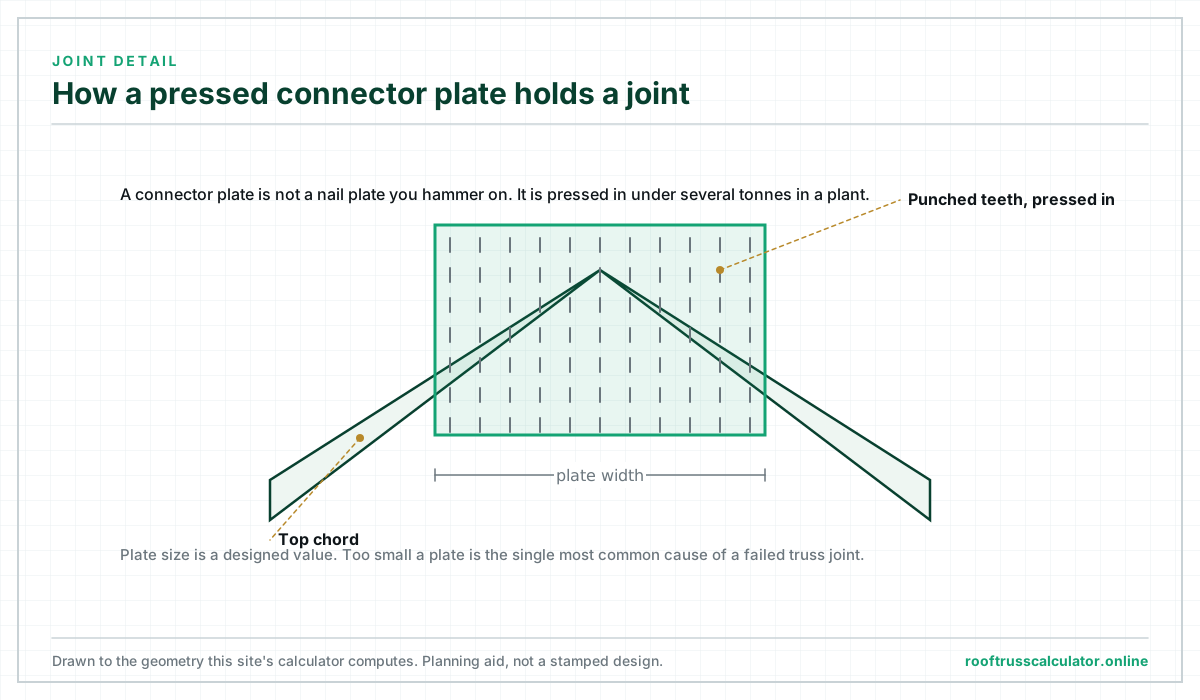
The pressed steel plates at every joint on a factory truss. They are punched from galvanised sheet with teeth stamped out of the plate itself, then hydraulically pressed into the wood.
Every member force at a joint transfers through those teeth. That has consequences worth knowing:
- A plate that has lifted, meaning backed partly out of the wood, has lost capacity in proportion to how far it lifted.
- A rusted plate has lost section.
- A plate damaged in transit means a rejected truss, not a truss to be hammered back in.
Inspect plates on delivery. Look for lifted plates, missing plates, and plates that do not sit flat.
Metal plate connected wood trusses are designed to ANSI/TPI 1, the national design standard published by the Truss Plate Institute (opens in a new tab), which covers plate design along with member sizing and the responsibilities of each party in the process.
Peak, span, rise and run
Peak is where the two top chords meet.
Span is the horizontal distance between the outside faces of the two bearing points. Not the room width. Not the building width including overhangs. Getting this wrong is the most common ordering error in the whole process.
Run is half the span on a symmetrical truss, measured horizontally from a bearing to the peak.
Rise is the vertical distance from the bottom chord to the peak.
Pitch is rise per twelve inches of run, written as 6:12.
For how these combine into the numbers you order from, see roof truss dimensions and sizing.
Camber
A deliberate upward curve built into the bottom chord, so that when the truss deflects under load the chord ends up straight rather than visibly sagging.
Long-span trusses are usually cambered. A bowed bottom chord on delivery is very often intentional rather than a fault.
Girder truss
A truss that carries other trusses. Girders are built from two, three or more plies fastened together with a specified nailing or bolting schedule, and they need designed bearing at each end.
They appear wherever the roof cannot run in one direction all the way across: at hip ends, over garage openings, and at any change in roof plane. They are the most expensive trusses in a package and the ones most often under-specified on a DIY plan.
Reading a truss drawing
Every fabricated truss ships with a drawing. It shows the profile with every member and panel point dimensioned, member sizes and grades, plate sizes and orientations, the design loads, bearing locations and required bearing lengths, reactions at each bearing, required permanent bracing, and the engineer’s seal.
Two things to check before anything else: the span matches your building, and the loads match your climate and intended use. Everything else follows from those two. If either is wrong, the truss is wrong no matter how well it was made.
Frequently asked questions
What is the top chord of a roof truss?
The sloping member running from the bearing point to the peak. It carries the roof sheathing and roofing, works mainly in compression, and continues past the wall as the overhang tail. Its capacity is governed by how far it runs between web connections.
Why can you not cut a roof truss bottom chord?
Because it is the tension tie holding the two walls together. Remove it, even partly, and the top chords spread outward under load. Every member in a truss is sized for a specific force, so cutting, notching or drilling any of them voids the engineering.
What is heel height on a roof truss?
The vertical depth of the truss directly over the bearing point. A standard heel leaves very little room for insulation above the wall plate. A raised or energy heel of ten inches or more allows close to full insulation depth there, which is where most roofs lose heat.
How do I know what my trusses were designed to carry?
From the truss drawing that came with them, which lists the design loads for both chords. If you do not have it, the loads cannot be inferred from the shape, and an engineer needs to inspect and evaluate before you add any load.
What is the difference between a web and a chord?
Chords are the outer members that form the outline: two sloping top chords and a horizontal bottom chord. Webs are the shorter members inside the triangle that connect them. Chords are continuous along the truss; webs transfer force between them.
Next step
The fastest way to make this vocabulary stick is to watch it move. Change the span, pitch or heel height in the roof truss calculator and see which members grow, which stay put, and how the peak height responds.